


Introduction to the Laz Language (Lazuri)
4 min read

Lazuri: A Unique and Endangered Language of the Caucasus
The Laz language, known to its speakers as Lazuri (or sometimes Lazuri nena, literally “the Laz tongue”), is one of the most fascinating and endangered languages in the world. Belonging to the South Caucasian (Kartvelian) language family, Lazuri represents an irreplaceable piece of humanity’s linguistic heritage, a living connection to the ancient civilizations of the Black Sea and Caucasus regions.
Linguistic Classification
Lazuri belongs to the Kartvelian language family, also known as the South Caucasian languages. This small but ancient language family consists of four languages: Georgian, Mingrelian, Laz, and Svan. Lazuri and Mingrelian together form the Zan branch of the Kartvelian family. They are sister languages that diverged approximately 2,000 years ago and retain significant mutual intelligibility, particularly in basic vocabulary and grammar.
The Kartvelian languages are a linguistic isolate: they are not demonstrably related to any other language family in the world. This makes every Kartvelian language, including Lazuri, exceptionally valuable for understanding human linguistic diversity and history.
Dialects
Lazuri has several recognized dialects, generally corresponding to geographic regions:
- Xopuri (spoken around Hopa and Kemalpaşa)
- Vizuri/Vit’suri (spoken around Fındıklı and Arhavi)
- Arkabuli/Ardeşenuri (spoken around Ardeşen and Çamlıhemşin)
- Atinuri/Pazaruri (spoken around Pazar and areas further west)
The eastern dialects (Xopuri and Vizuri) are generally considered more conservative, retaining features closer to proto-Zan, while the western dialects show greater Turkish influence.
Endangered Status
UNESCO classifies Lazuri as “definitely endangered.” The number of native speakers is estimated at between 20,000 and 30,000, though some estimates are lower. Critically, the vast majority of fluent speakers are over 40 years old, and intergenerational transmission of the language has largely ceased in most communities. Young Laz people in Turkey typically grow up speaking Turkish as their primary language, with Lazuri reduced to a few phrases or passive understanding.
Writing Systems
Lazuri was not historically a written language; its rich oral tradition was transmitted through songs, stories, prayers, and everyday speech. The first attempts to create a written form came in the 20th century:
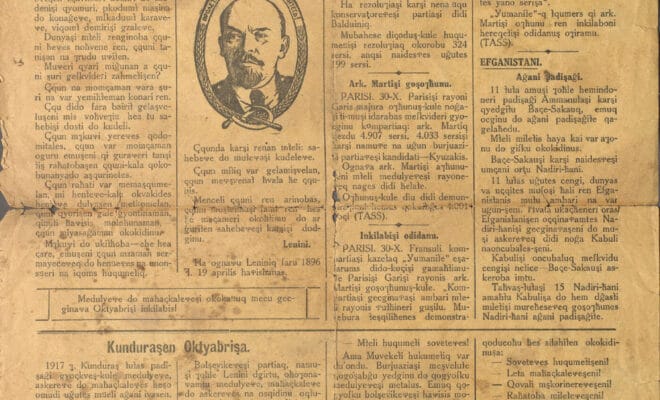
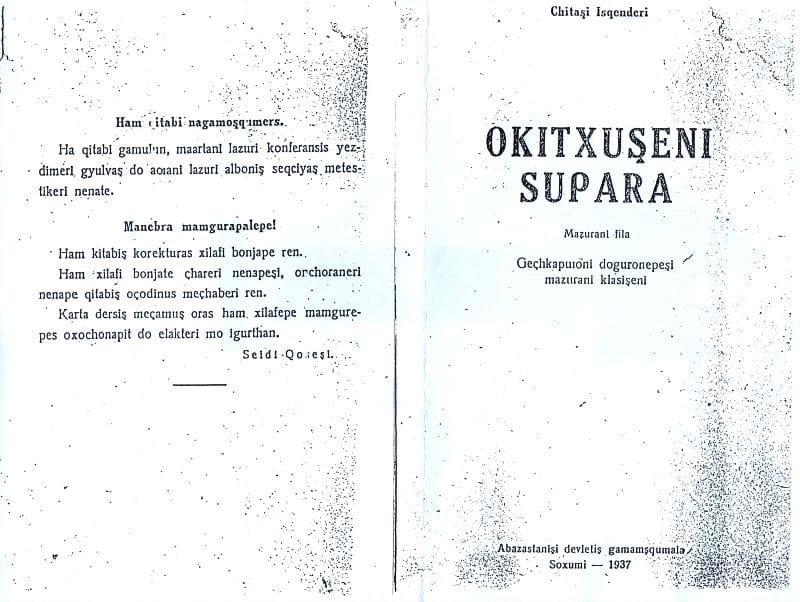
- 1929: Iskender Tzitashi (İskender Chitashi), a Laz intellectual living in the Soviet Union, created the first Laz alphabet based on the Latin script. This alphabet was used for a brief period before Soviet language policies shifted to Cyrillic-based alphabets for minority languages.
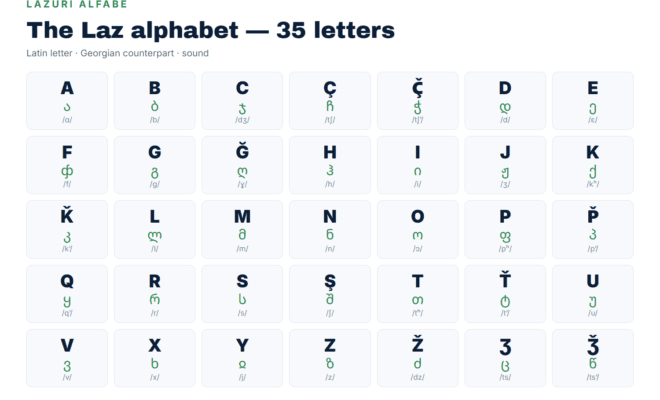
- 1984: A modern Latin-based alphabet for Lazuri was developed in Turkey by Wolfgang Feurstein, a German linguist, in collaboration with Laz intellectuals. This alphabet, with some modifications, has become the standard writing system for Lazuri.
- 1999: The first comprehensive Laz-Turkish dictionary was published, a landmark achievement for Laz literacy and language documentation.
Language Revitalization Efforts
The Laz Institute (Lazuri Enstitü), established in the early 2000s, has been at the forefront of efforts to preserve and revitalize the Laz language. The institute has published textbooks, dictionaries, and literary works in Lazuri, and has advocated for the inclusion of Laz language education in Turkish schools.
In 2013, Lazuri was briefly offered as an elective language course in some Turkish schools under a government reform allowing minority language education, but implementation has been limited and inconsistent. Social media and digital platforms have emerged as important new spaces for Laz language use, with Facebook groups, YouTube channels, and websites providing content in Lazuri.
Despite these efforts, the survival of Lazuri as a living language remains precarious. Without sustained institutional support, formal education programs, and a dramatic increase in intergenerational transmission, the language risks falling silent within a generation or two. The preservation of Lazuri is not merely a linguistic issue. It is a matter of cultural survival for the Laz people.
Sources
- Laz language on Wikipedia
- Kartvelian languages on Wikipedia