

Lazepe

Top Menu

  • History
  • Language & Literature
  • Music & Dance
  • News & Articles

Main Menu

  • Home
  • The Laz People
    • Who are the Laz?
    • Laz Tribes and Clans
    • Religion
    • Famous Laz People
      • Laz Musicians
      • Laz Historical Figures
      • Laz Writers & Academics
      • Laz Politicians & Military
  • Lazistan
    • Geography
    • Maps
    • History
    • Flag and Symbols
    • Demographics
    • Human Rights
  • Laz Language
    • Laz Alphabet
  • News & Articles
  • Interviews
  • Contact
  • History
  • Language & Literature
  • Music & Dance
  • News & Articles

logo

Lazepe

  • Home
  • The Laz People
    • Who are the Laz?
    • Laz Tribes and Clans
    • Religion
    • Famous Laz People
      • Laz Musicians
      • Laz Historical Figures
      • Laz Writers & Academics
      • Laz Politicians & Military
  • Lazistan
    • Geography
    • Maps
    • History
    • Flag and Symbols
    • Demographics
    • Human Rights
  • Laz Language
    • Laz Alphabet
  • News & Articles
  • Interviews
  • Contact
History
Home›History›The Sanjak of Lazistan: An Ottoman Province Named After the Laz

The Sanjak of Lazistan: An Ottoman Province Named After the Laz
By Lazepe
June 6, 2026
3
0
Share:
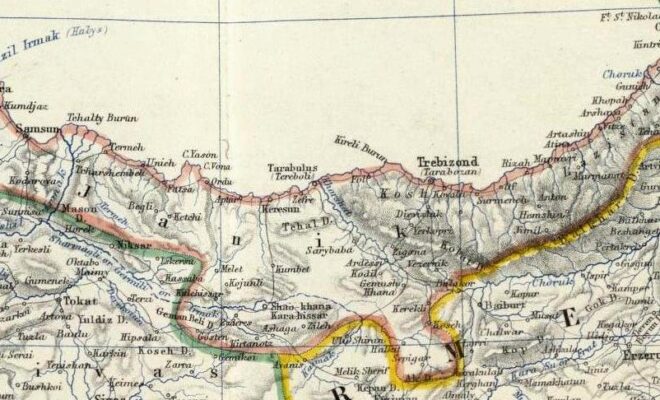
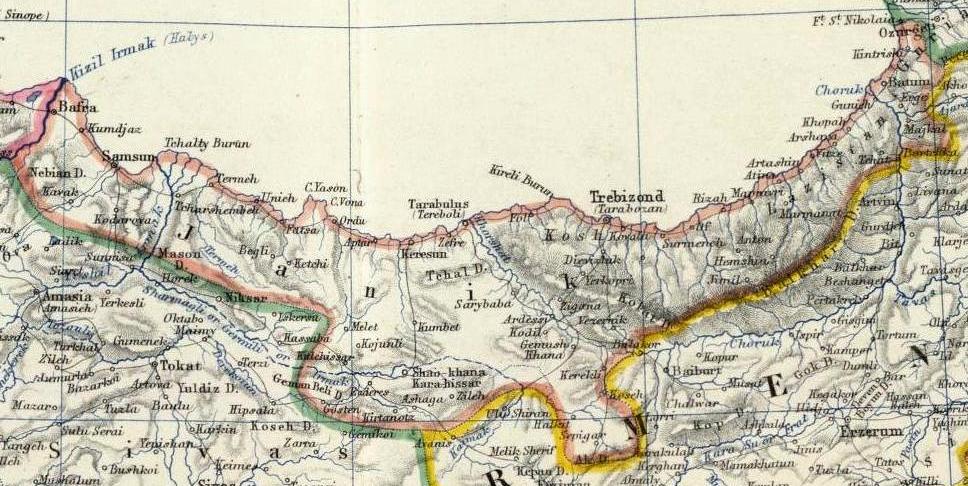
1861 map of the eastern Black Sea and Transcaucasia

For centuries the homeland of the Laz had its own place on the Ottoman map: the Sanjak of Lazistan, an administrative province that carried the name of its people.
Table of Contents

Toggle
  • From conquest to province
  • A shifting capital
  • A name erased

From conquest to province

After the Ottomans absorbed the Empire of Trebizond and pushed east in the 16th century, they organised the eastern Black Sea coast into the Sanjak of Lazistan, part of the larger province of Trabzon. It stretched along the coast between Trabzon and Batum, covering roughly today’s Rize Province and the coast of Artvin, and was divided into the districts (kazas) of Of, Rize, Atina (Pazar) and Hopa.

A shifting capital

The sanjak was first governed from the coastal fortress of Gonia, then from Batum, the great port of the region. When Batum was lost to the Russian Empire after the war of 1877-78, Rize became the capital, the role it still holds as the regional centre of Lazistan today.

A name erased

The Sanjak of Lazistan survived until the fall of the empire in 1923. A few years later, in 1926, the new republic officially banned the very name “Lazistan,” and the territory was split between the provinces of Rize and Artvin. The administrative name disappeared, but the identity it described did not.

Learn more: Lazistan Sanjak on Wikipedia.

Map: the eastern Black Sea and Transcaucasia, by A. K. Johnston, 1861 (public domain), via Wikimedia Commons.

Previous Article

The Lazic War (541-562): Byzantium and Persia ...

Next Article

The Christianization of Lazica

Share:

Related articles More from author

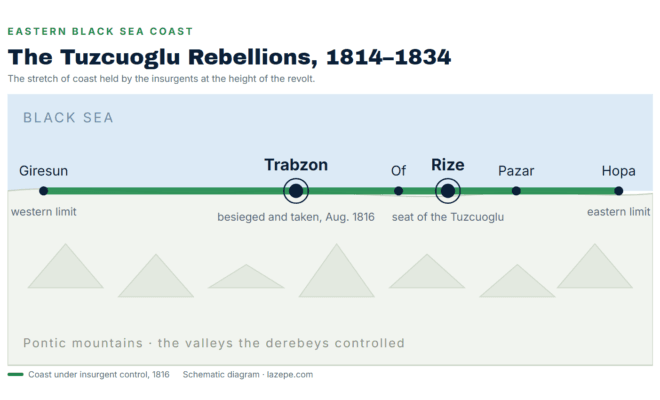
  • Map of the Tuzcuoglu rebellion against the Ottomans
    History

    The Tuzcuoglu Rebellions: Laz Revolt Against the Ottomans (1814-1834)

    March 26, 2026
    By Lazepe
  • Historical photograph of Laz people along the Coruh River
    History

    The Rize Attack

    March 26, 2026
    By Lazepe
  • Kingdom of Lazica
    History

    The Kingdom of Lazica (Egrisi): A Forgotten Caucasian Kingdom

    March 26, 2026
    By Lazepe
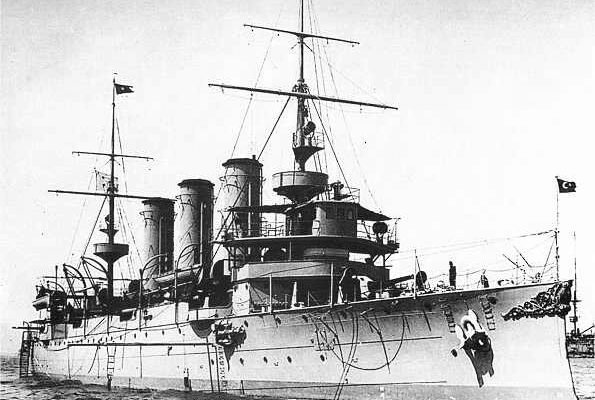
  • The Ottoman cruiser Hamidiye
    History

    The Rize Hat Revolt of 1925: The Hamidiye and the Hangings

    June 6, 2026
    By Lazepe
  • The Forty Martyrs Church at Nokalakevi
    History

    The Christianization of Lazica

    June 6, 2026
    By Lazepe
  • Muhacir refugees of the late Ottoman period
    History

    The Laz Migrations: Muhacir of the Black Sea

    June 6, 2026
    By Lazepe

Leave a reply Cancel reply

  • Ruins of Nokalakevi, ancient capital of the Kingdom of Lazica
    Famous Laz PeopleLaz Historical Figures

    King Gubazes II of Lazica

  • Illustration of Laz language and literature
    Language & Literature

    Lazuri Nena: A Grammar of the Laz Language

  • Fresco of John the Laz in Jerusalem
    Famous Laz PeopleLaz Historical Figures

    John the Laz (Ioane Lazi)

Support Lazepe

Help keep the Laz language, music and history alive for the next generation.

Make a donation Every contribution counts

Follow us

Articles

News & Articles

Welcome to Lazepe.com

  • Laz peoples

    The Laz Diaspora: Communities Around the World

    By Lazepe
    March 26, 2026
  • Zilkale Castle in Camlihemsin, Rize, Lazistan

    The Beauty of Lazistan: Landscapes of the Eastern Black Sea

    By Lazepe
    March 26, 2026

Interviews

Interviews

Ismail Avci Bucaklisi: A Voice for the Laz Language

Our Logos

Lazepe Logo ColoredLazepe Logo White

About Lazepe

Lazepe.com is an independent Laz website that publishes news, articles, interviews, historical documents, literary works, photographs, music and videos about the Laz people.

Lazepe

Independent Laz website that publishes news, articles, interviews, historical documents, literary works, photographs, music and videos.

Subscribe to our Newsletter

Last Publications

  • June 6, 2026

    The Laz Migrations: Muhacir of the Black Sea

  • June 6, 2026

    John the Laz (Ioane Lazi)

  • June 6, 2026

    The Rize Hat Revolt of 1925: The Hamidiye and the Hangings

  • June 6, 2026

    The Conversion of the Laz to Islam

  • June 6, 2026

    The Christianization of Lazica

Most Commented

  • Muhacir refugees of the late Ottoman period
    History

    The Laz Migrations: Muhacir of the Black Sea

    By Lazepe
    June 6, 2026
    0
  • Firtina Valley in Rize, the heart of Lazistan
    News & Articles

    Welcome to Lazepe.com

    By Lazepe
    March 26, 2026
    0
  • Horon dancers on the Black Sea coast
    Music & Dance

    Laz Traditional Dances: The Horon

    By Lazepe
    March 26, 2026
    0
  • Kingdom of Lazica
    History

    The Kingdom of Lazica (Egrisi): A Forgotten Caucasian Kingdom

    By Lazepe
    March 26, 2026
    0
  • Privacy Policy
  • Donation
  • Contact
© 2026 Lazepe · Independent Laz culture, language & history project