




Lazepe

Top Menu

  • History
  • Language & Literature
  • Music & Dance
  • News & Articles

Main Menu

  • Home
  • The Laz People
    • Who are the Laz?
    • Laz Tribes and Clans
    • Religion
    • Famous Laz People
      • Laz Musicians
      • Laz Historical Figures
      • Laz Writers & Academics
      • Laz Politicians & Military
  • Lazistan
    • Geography
    • Maps
    • History
    • Flag and Symbols
    • Demographics
    • Human Rights
  • Laz Language
    • Laz Alphabet
  • News & Articles
  • Interviews
  • Quiz
  • Contact
  • History
  • Language & Literature
  • Music & Dance
  • News & Articles

logo

Lazepe

  • Home
  • The Laz People
    • Who are the Laz?
    • Laz Tribes and Clans
    • Religion
    • Famous Laz People
      • Laz Musicians
      • Laz Historical Figures
      • Laz Writers & Academics
      • Laz Politicians & Military
  • Lazistan
    • Geography
    • Maps
    • History
    • Flag and Symbols
    • Demographics
    • Human Rights
  • Laz Language
    • Laz Alphabet
  • News & Articles
  • Interviews
  • Quiz
  • Contact
Music & Dance
Home›Music & Dance›Traditional Tulum Music of Lazistan

Traditional Tulum Music of Lazistan
By Lazepe
March 26, 2026
26
0
Share:
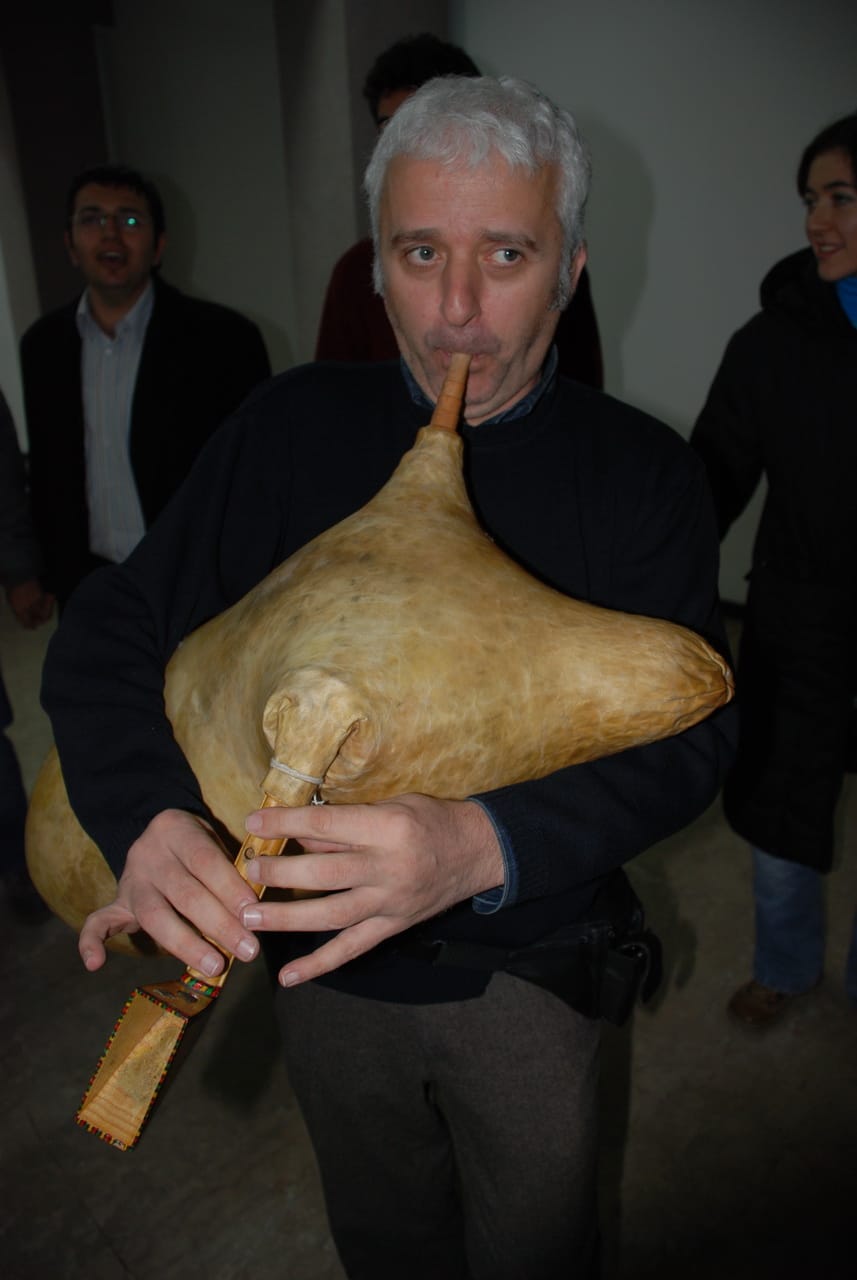
Laz musician Birol Topaloglu playing the tulum bagpipe

The tulum (Lazuri: guda) is the iconic bagpipe of the eastern Black Sea coast and one of the most recognisable sounds of Lazistan. Unlike the Scottish bagpipe, the tulum has no drone: it uses two parallel melody pipes, which give it a continuous, buzzing, deeply rhythmic voice that can drive dancers for hours.

Table of Contents

Toggle
  • How it is made
  • The heartbeat of Laz celebration
  • Recognised heritage

How it is made

The instrument is built from a whole goat or sheep skin, cleaned and cured for several days in a mixture of water, corn flour, yoghurt and salt. A double melody pipe (the cifte), carved from boxwood and pierced with finger holes, is fixed to one leg of the skin; a simple blowpipe with a leather valve is tied to the other. The player inflates the bag under one arm and squeezes it steadily to keep the sound unbroken.

The heartbeat of Laz celebration

The tulum is inseparable from the horon, the fast circle dance of the Black Sea. At weddings, highland festivals and village gatherings it sets the relentless tempo that dancers follow shoulder to shoulder. It is often joined by the kemence, a three-stringed fiddle, and at larger events by the davul and zurna.

The instrument is not Laz alone: it is shared by the Hemshin, the Black Sea Turks and the Pontic Greeks, making it a common cultural thread across the whole region. Musicians such as Birol Topaloglu have devoted their careers to recording and reviving traditional tulum repertoire before it disappears.

Recognised heritage

The craft of making and playing the regional bagpipe is inscribed by UNESCO on its list of intangible cultural heritage, a sign of how central this humble goatskin instrument is to the identity of the communities that play it.

Learn more: Tulum (bagpipe) on Wikipedia and the UNESCO Intangible Cultural Heritage list.

Header photo: Laz musician Birol Topaloglu playing the tulum, by Macukali, CC BY-SA 4.0.
Previous Article

The Kemence: The Fiddle of the Black ...

Next Article

Ismail Avci Bucaklisi: A Voice for the ...

Share:

Related articles More from author

  • A Black Sea kemence fiddle
    Music & Dance

    The Kemence: The Fiddle of the Black Sea

    March 26, 2026
    By Lazepe
  • Horon dancers on the Black Sea coast
    Music & Dance

    Laz Traditional Dances: The Horon

    March 26, 2026
    By Lazepe

Leave a reply Cancel reply

  • First page of Mcita Murutskhi, the first Laz newspaper, 1929
    Language & Literature

    Mcita Murutskhi: The First Laz Newspaper (1929)

  • Ruins of the Petra fortress in Lazica
    History

    The Lazic War (541-562): Byzantium and Persia Fight for Lazica

  • Illustration of Laz language and literature
    Language & Literature

    Lazuri Nena: A Grammar of the Laz Language

Support Lazepe

Help keep the Laz language, music and history alive for the next generation.

Make a donation Every contribution counts

Follow us

Articles

News & Articles

Welcome to Lazepe.com

  • Laz peoples

    The Laz Diaspora: Communities Around the World

    By Lazepe
    March 26, 2026
  • Zilkale Castle in Camlihemsin, Rize, Lazistan

    The Beauty of Lazistan: Landscapes of the Eastern Black Sea

    By Lazepe
    March 26, 2026

Interviews

Interviews

Ismail Avci Bucaklisi: A Voice for the Laz Language

Our Logos

Lazepe Logo ColoredLazepe Logo White

About Lazepe

Lazepe.com is an independent Laz website that publishes news, articles, interviews, historical documents, literary works, photographs, music and videos about the Laz people.

Lazepe

Independent Laz website that publishes news, articles, interviews, historical documents, literary works, photographs, music and videos.

Subscribe to our Newsletter

Last Publications

  • June 6, 2026

    The Laz Migrations: Muhacir of the Black Sea

  • June 6, 2026

    John the Laz

  • June 6, 2026

    The Rize Hat Revolt of 1925: The Hamidiye and the Hangings

  • June 6, 2026

    The Conversion of the Laz to Islam

  • June 6, 2026

    The Christianization of Lazica

Most Commented

  • Muhacir refugees of the late Ottoman period
    History

    The Laz Migrations: Muhacir of the Black Sea

    By Lazepe
    June 6, 2026
    0
  • Firtina Valley in Rize, the heart of Lazistan
    News & Articles

    Welcome to Lazepe.com

    By Lazepe
    March 26, 2026
    0
  • Horon dancers on the Black Sea coast
    Music & Dance

    Laz Traditional Dances: The Horon

    By Lazepe
    March 26, 2026
    0
  • Kingdom of Lazica
    History

    The Kingdom of Lazica (Egrisi): A Forgotten Caucasian Kingdom

    By Lazepe
    March 26, 2026
    0
  • Privacy Policy
  • Donation
  • Contact
© 2026 Lazepe · Independent Laz culture, language & history project